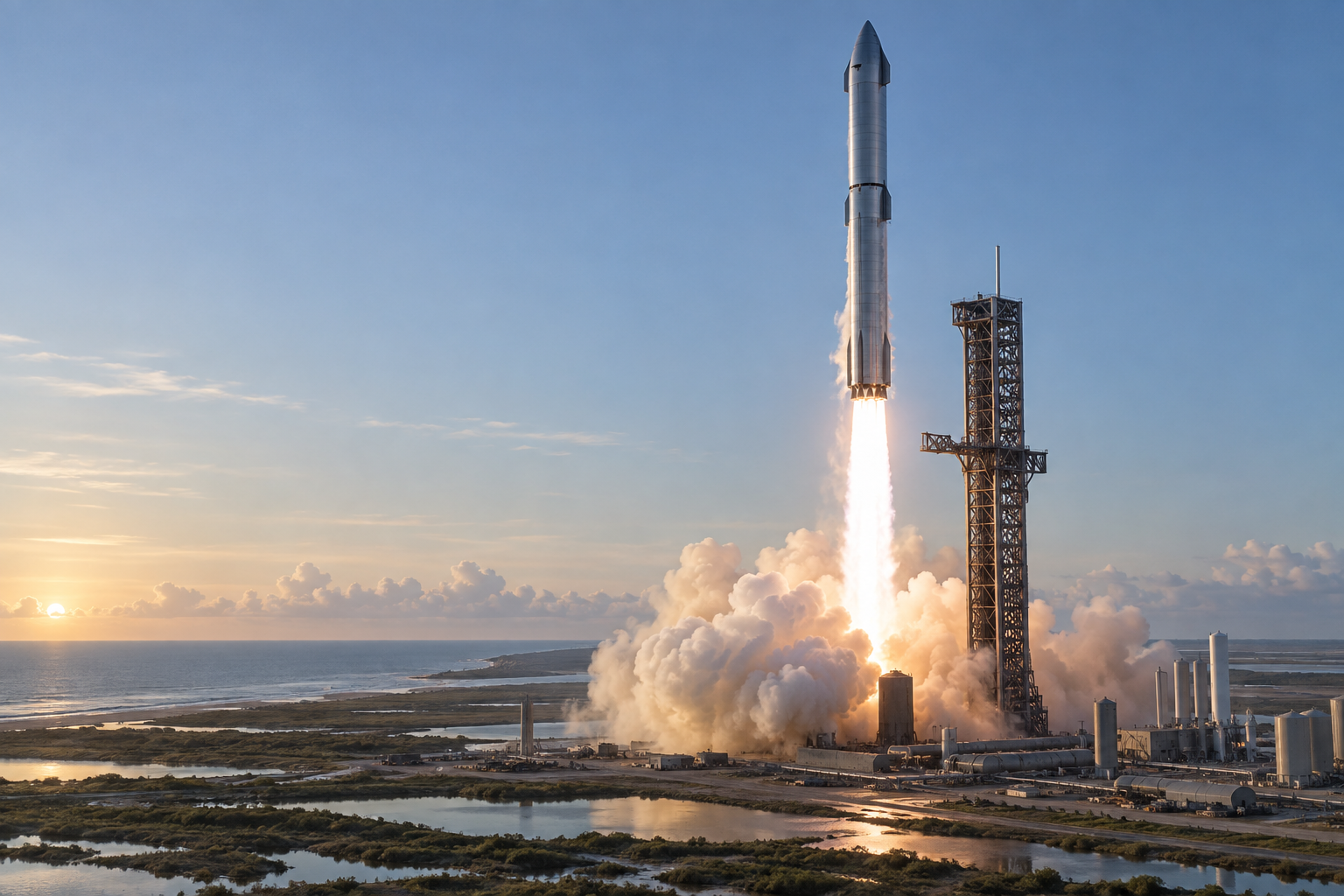
SpaceX's latest launch gave Starship a milestone the program had been working toward for years. Flight 14 lifted off from Pad 2 at Starbase, Texas, at 12:48 UTC on September 28 and went on to reach Earth orbit. The vehicle then released 26 next-generation Starlink V3 satellites. The mission was not a flawless execution of its original plan: the upper stage came back after about three hours instead of the nearly ten hours SpaceX had prepared for. Still, an orbital flight with an operational satellite deployment marked a major step beyond the program's earlier suborbital tests.
A launch with two distinct goals
Starship is a two-stage system. The Super Heavy booster supplies the thrust needed to lift the vehicle through the thick lower atmosphere; the Ship upper stage continues toward space and carries the payload. On Flight 14, Super Heavy separated, turned back and made a controlled splashdown in the Gulf of Mexico. No catch at the launch tower was planned for this test. The upper stage continued to the orbital insertion maneuver that earlier full-size Starship flights had not completed.
The ascent was closely watched because an upper-stage engine stopped operating. Flight controllers assessed whether the vehicle still had enough capability to enter orbit and, crucially, to leave it safely later. A brief engine firing after the main ascent put Ship into orbit. This distinction matters: simply reaching space is not the same as achieving a sustained orbit around Earth, and SpaceX had intentionally kept its previous Starship flights on suborbital paths.
The 26-satellite deployment
Once the spacecraft was in orbit, it deployed a batch of 26 Starlink V3 broadband satellites. SpaceX had previously released V3 hardware on Flight 13, but those spacecraft followed a suborbital trajectory and were expected to reenter quickly. Flight 14's payload was sent into an orbital path instead. For Starship, this turns a flight test into a demonstration of actual payload delivery, the job a launch vehicle ultimately needs to perform routinely.
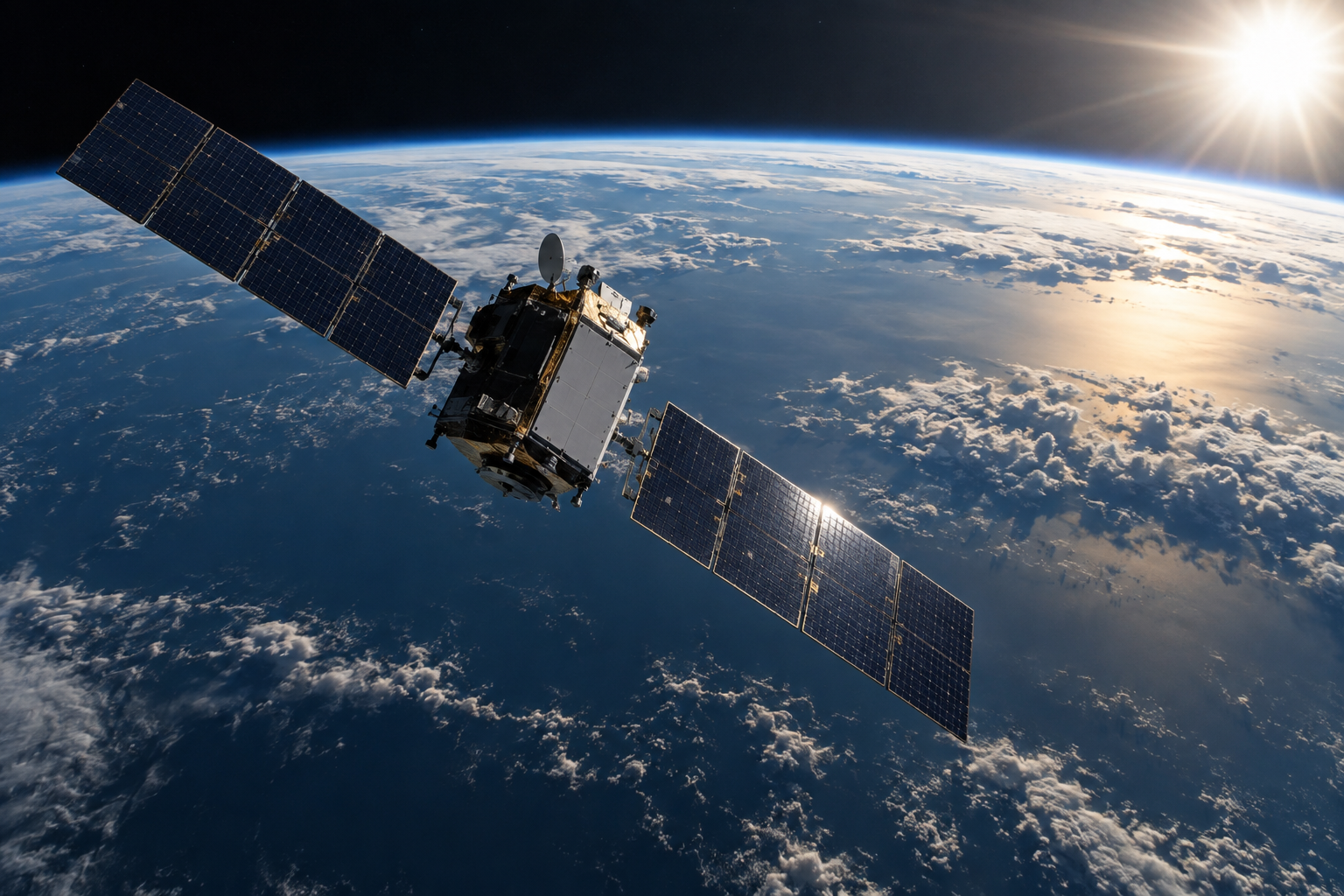
Deployment is one milestone, not the end of the satellites' story. Engineers still need to check the spacecraft after separation, establish communication, and confirm that they can take up their intended roles in the Starlink network. The launch showed that Starship could carry and release this batch; it did not, by itself, establish the final in-service performance of all 26 satellites.
Why the flight ended early
The original mission profile called for Ship to circle Earth for roughly ten hours before a planned deorbit burn and splashdown farther south in the Pacific. Instead, controllers chose an earlier return. The upper stage reentered and made a controlled splashdown in the northern Pacific about three hours and eight minutes after liftoff. The change did not undo the orbital insertion or satellite deployment, but it shortened the amount of time available for the planned in-space coast and observations.
As of this report, the company has not published a full post-flight engineering account explaining every decision behind the shorter mission. That is an important limit on early coverage. It is reasonable to describe the achieved milestones and the changed flight path; assigning a definitive cause to the early return would go beyond the information available on launch day.
What comes next for Starship
Flight 14 demonstrated three things that can be stated plainly: Starship launched, its upper stage reached orbit, and it deployed the planned Starlink payload. It also illustrated how much development work remains. SpaceX's longer-term concept depends on bringing both stages back, refurbishing them quickly and flying them again. Neither vehicle was recovered for reuse on this mission. Future missions will have to show that the orbital phase, reentry, landing and turnaround can be repeated reliably, not merely accomplished once.
The difference matters for two separate ambitions. Starlink needs a high-capacity launch system to place larger numbers of newer satellites in orbit. Plans for lunar and more distant flights add further requirements, including in-space propellant transfer and systems suited to carrying people. Flight 14 advances the first of those tasks, but it is not proof that the entire transportation system is ready for crewed exploration.
For now, the clearest reading of the latest launch is neither an unqualified victory lap nor a failure because the flight was shorter than planned. SpaceX crossed an orbital and payload-delivery threshold while accepting a change to the return profile. The engineering review that follows will determine what the company can carry into its next flight.
Sources
Mission details and planned objectives: SpaceX Flight 14 mission page. Launch-day timing, orbital insertion, payload deployment and early splashdown: Space.com launch report. This article reflects information available on September 28, 2026.